
If you are trying to start a business with a small budget, green entrepreneurship can be a smart business angle, not a charity project. It usually works when you reduce waste, reduce costs, or help customers meet new rules. In this post, I explain what green entrepreneurship means in plain terms, then share 10 practical examples you can start on a low budget, plus a simple validation plan and how to avoid greenwashing.
What is green entrepreneurship?
Green entrepreneurship means building a profitable business while reducing environmental harm in a measurable way. It is not “being eco-friendly” as a brand story. It is a normal business where the product or service creates a clear “less harm” outcome, like using less energy, reducing waste, or extending product life.
I like to think about it in one simple test: can I show proof without marketing words? If the answer is yes, the business can be green without sounding fake.
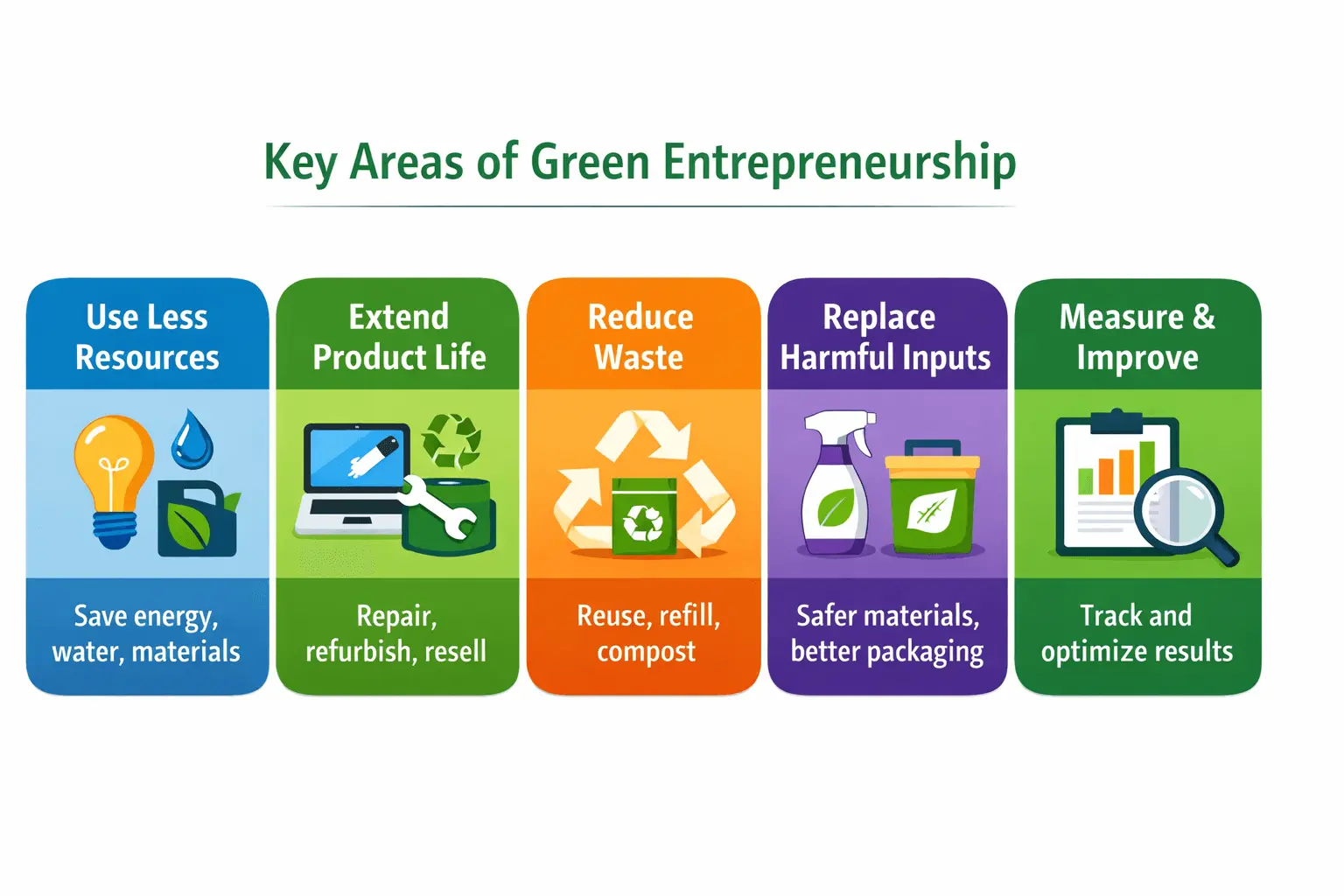
Most green businesses fit into a few practical buckets:
- Use less resources: less energy, water, fuel, or raw materials
- Extend product life: repair, refurbish, resale, upgrades, rentals
- Reduce waste: reuse, refill, compost, right-sizing, smarter logistics
- Replace harmful inputs: safer chemicals, better packaging, lower-tox alternatives
- Measure and improve: track outcomes so the improvements are real over time
If you plan to market “green” benefits, keep your claims specific and provable. The FTC Green Guides is a good reference for how environmental claims should be described. For emissions reporting language and structure, the GHG Protocol is a common starting point.
The 10 green entrepreneurship examples (low budget, practical)
1) Home energy quick audits for renters and homeowners
This is a simple service where you review a home and find fast, low-cost ways to reduce energy waste. Many people feel their electricity bill is “high for no reason”, but they do not know what to change first. A quick audit gives them clarity and a short action list.
A good offer here is a checklist-based audit with a clear “top fixes” plan. It can be done in person or even as a guided video call if you have a clear process.
What makes this work is proof. Instead of big promises, show what changed. For example: replaced bulbs, reduced standby power, fixed gaps, changed AC settings. Track estimated kWh savings based on what was actually done, not just what you suggested.
2) After-hours energy setup for small businesses
Small shops and offices waste energy after closing more often than people think. Lights stay on, signage stays on, devices run overnight, and AC settings are not controlled well. This can be sold as a practical “reduce wasted electricity” setup.
The service can be very lightweight: a short audit, a few rules and schedules, and a staff checklist. You can also include a basic “close down routine” that makes it easy for employees to follow. For ideas and terminology, ENERGY STAR has useful guidance for buildings and savings habits.
This is a strong business because the customer does not need to care deeply about sustainability. They care about costs. If you can help them reduce waste without disrupting operations, it becomes an easy yes.
3) Sustainable packaging advisor for e-commerce brands
Many e-commerce brands want to reduce packaging waste, but their real pain is usually different: shipping damage, high returns, and rising shipping costs. Packaging that is too large or poorly designed creates both waste and customer complaints.
A simple offer is a packaging review based on real shipments. Review the last 20 to 50 orders, look at product sizes, packaging sizes, fill material, and damage rate. Then recommend 3 to 5 changes they can apply next week. You do not need a warehouse or complex tooling to start. A spreadsheet, a clear checklist, and supplier options are enough.
To keep this credible, avoid vague claims like “eco-friendly packaging”. Be specific about what changes: lower packaging weight per order, fewer plastic fillers, right-sized boxes, reduced damage. Those are measurable outcomes that also support the “green” angle naturally.
4) Electronics repair and refurb (start with one niche)
Repair and refurb is one of the most practical green entrepreneurship examples because it extends product life. The key is to start with one niche, not “all repairs”. For example: laptop SSD upgrades, laptop cleaning and thermal paste service, battery replacement for a specific phone model range, or basic screen repairs.
Customers pay because repair is cheaper than replacement and saves time. For small businesses, downtime is expensive too, so pickup and delivery can become a strong differentiator even if you charge a bit more.
Trust matters a lot here. Use a clear fixed-price menu, clear warranty terms, and strong reviews. The “green” proof is simple: number of devices repaired instead of replaced. Keep it honest and focused.
5) Niche resale brand (one category, one audience)
Resale can look like a crowded space, but niche resale still works when you build trust. The difference is positioning: you are not a random thrift page. You are a focused store for one category, like office chairs, baby gear, camera gear, or outdoor equipment.
A low-budget way to start is consignment. That means you sell on behalf of owners and take a fee, instead of buying inventory upfront. It reduces risk and helps you learn what sells fast. Over time, you can selectively buy the best items to grow margins.
What makes a niche resale business feel premium is grading and inspection. Clear condition labels, honest photos, and a simple return policy can beat larger competitors who feel messy and uncertain.
6) Compost pickup subscription for households and cafes
Compost pickup is a route-based subscription model. It works well because the behavior is repeatable and the customer benefit is clear: cleaner waste handling and less trash.
A low-budget start is one neighborhood route on one or two days per week. You can start with households, but cafes and small restaurants are often even better early customers because they create consistent volume and want a cleaner waste system.
To build trust, show the basics: where it goes, how it is handled, and simple monthly stats. Tracking kilograms diverted per month is a clean metric that is easy to understand and not easy to fake.
7) Refill delivery for basic cleaning products
Refill businesses often fail when they rely on “being green” as the only reason. The better angle is convenience and predictable pricing. If customers can get refills delivered on a schedule, they do not need to think about it.
Start with 3 to 5 products only, such as dish soap, hand wash, laundry liquid, and a multi-surface cleaner. Use a deposit container system so containers come back. Keep ordering simple, even if it is just a form and WhatsApp in the beginning.
This is another idea where proof is easy: containers reused and estimated plastic avoided. Avoid big claims. Focus on what you can measure.
8) Eco-friendly cleaning service for homes and small offices
Cleaning is not “green” just because the bottle says so. A better approach is a clear, safer process: measured concentrates, ventilation rules, microfiber systems, and avoiding harsh chemicals where not needed.
People pay for cleaning when it is consistent and reliable. The green angle helps, but the core value is still quality and trust. This is why reviews matter more than anything else here.
If you want to position it well, publish a simple “what we use and why” list, and be clear about what you do not do. That kind of clarity supports E-E-A-T because it shows you have a real process, not marketing fluff.
9) Furniture repair and upgrade service
Furniture is expensive to replace, and delivery times can be slow. Repair and upgrades are often faster and cheaper, which makes this a practical business even before customers care about sustainability.
Start with one skill: chair repair, refinishing, hardware upgrades, or minor structural fixes. Offer pickup and delivery if possible because convenience is a big reason people replace furniture instead of repairing it.
This business becomes strong when you show results. Before and after photos are powerful here. Just keep your wording careful. Say “repaired” and “extended life”, not “saved the planet”.
10) Carbon footprint starter reports for small businesses
Disclaimer: I’m not offering legal advice, and I’ll be clear about assumptions and data quality
Some small businesses now get asked about emissions by partners, buyers, or corporate clients. Many do not need a perfect report. They need a baseline and a plan, using a known method.
A starter service can use utility bills, fuel spending, travel logs, and shipping records to create a basic footprint. The GHG Protocol Corporate Standard gives a common structure and language for this type of work.
This is a trust-heavy service. The right approach is to be clear about scope, assumptions, and data quality. Avoid fake precision. The value is often in the improvement plan: practical actions like energy changes, transport changes, and supplier improvements that can be tracked over time.
My “start this next week” validation plan (simple and founder-friendly)
If I wanted to test one of these green entrepreneurship examples quickly, this is what I would do:
- Pick one idea that matches my skills and has reachable buyers
- Write a one-sentence offer: who it is for and the outcome
- Build a one-page landing page with price range and what’s included
- Make a list of 50 leads from local search, LinkedIn, and directories
- Do outreach and sell 1 paid pilot
- Turn the pilot into a repeatable package and collect reviews
This keeps it practical. It also reduces the risk of building something nobody buys.
E-E-A-T and trust: how I avoid greenwashing
Green topics are trust-sensitive. I do not use big claims.
What I avoid:
- “Eco-friendly” with no details
- “100% green” style language
- Fake certifications or unclear badges
What I do instead:
- Make claims specific and narrow (example: “plastic-free packaging for this product”)
- Show proof (photos, bills, measurements, supplier docs)
- Use known references when I talk about rules and standards:
Conclusion
Green entrepreneurship works best when you treat it like a normal business: clear customer pain, clear offer, measurable outcomes, and honest marketing. The green entrepreneurship examples above are not “perfect world” ideas. They are practical, low-budget ways to build a business that helps customers while reducing waste or emissions.