

If you write blog posts and feel like you are doing “SEO content writing” but rankings still do not move, you are usually not missing a secret trick. You are missing a repeatable workflow.
I recently watched this video by Matt Diamante: 5 SEO Content Writing Mistakes That Are Killing Your Rankings. His points are very practical. In this post, I will expand them into a full publishing system you can use on Peak Lora (or any blog).
The “Rank-Ready” Workflow (use this every time)
Before we talk about mistakes, here is a simple workflow that prevents most of them.
Step 1: Start with proof, not a blank page
Instead of writing from scratch, start from something real:
- A short voice note where you explain the topic
- A Loom-style screen recording
- Notes from a client call (remove private details)
- Your own experience, numbers, screenshots, test results, or mistakes you made
This naturally improves E-E-A-T because you are not guessing. You are reporting real experience, which is a big theme in Google’s quality guidance and rater guidelines: Creating helpful, reliable, people-first content and the Search Quality Rater Guidelines.
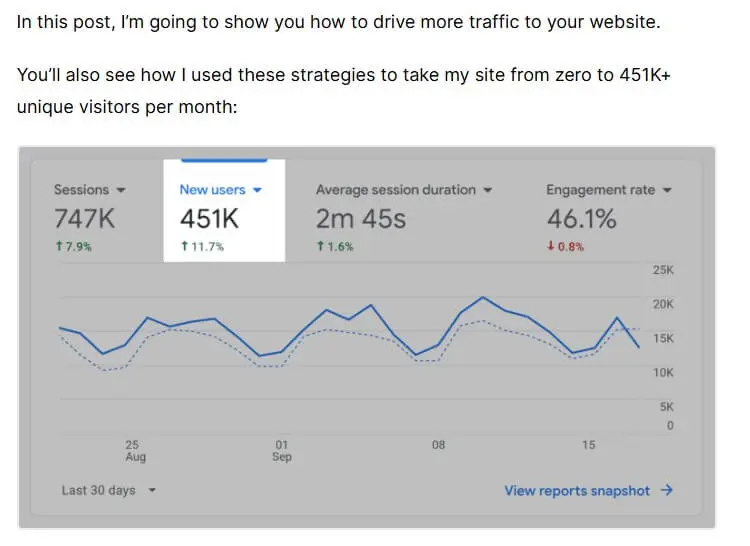
I have seen Brian from Backlinko usually do this in most posts, like below.
Step 2: Choose a “winnable” keyword (low difficulty, clear intent)
Your goal is not the biggest search volume. Your goal is the easiest keyword where you can give the best answer.
A fast filter:
- Long tail keywords (5+ words)
- Clear intent (the searcher wants one outcome)
- Low keyword difficulty (if you use tools, target something like 0–30 as Matt suggests)
Also check trend direction. A smaller keyword that is stable or growing can beat a bigger keyword that is dying.
Step 3: Build an outline that matches intent fast
Open the top results and ask:
- What is the intent? Checklist, tutorial, definition, comparison, examples?
- What do they answer in the first 10 seconds of reading?
- What questions are left unanswered?
Use competitor structure as a reference, but do not copy it.
Step 4: Add your “human-only” layer
This is where rankings are won.
Add at least 2–4 of these:
- A personal story that explains “why this matters”
- A real example from your work
- A process you actually use
- Numbers you observed (even small numbers)
- Mistakes you made and how you fixed them
- A mini checklist you created from experience
This is how you stop sounding like rewritten SERP content.
Step 5: Optimize basics, then promote
Google is very direct about basic SEO best practices in its starter docs: SEO Starter Guide.
Then promote the post like a product launch, not like a diary entry.
Now, let’s go through the mistakes (including Matt’s five), plus a few extras that matter a lot in 2025 and beyond.
Mistake 1: Writing from scratch without a strategy
What happens: You start at a blank page, write what you think an SEO post should sound like, and the result is “fine” but forgettable.
Why it kills rankings: “Fine” content is easy to produce now. If your post has no real experience, it blends into the internet.
Fix: Start from real material: audio, video, notes, or personal experience. Then turn it into an article. Matt’s point is simple: your natural expertise comes through when you speak first, then write.
Tip: Make a habit of recording a 5–8 minute voice note before writing. Even if you never publish the audio, it becomes your “unique angle bank”.
Mistake 2: Chasing high-difficulty keywords you cannot win
What happens: You target huge keywords like “SEO” or “content marketing” and compete with giants.
Why it kills rankings: Those SERPs are dominated by high authority sites with years of links, history, and topical depth.
Fix: Do keyword gap research and look for low difficulty terms where you can be the most useful answer. Matt recommends filtering difficulty around 0–30. That is a good starting point.
An example from this blog:
- Low-Cost Marketing Ideas for Small Startups Using AI – I could have just written “marketing ideas,” but I went with a long-tail keyword by adding “small startup” and “AI.” It makes the keyword longer and less competitive because there aren’t thousands of blogs covering that exact topic. If I had written just about “marketing ideas,” it would be really hard to rank since big brands have thousands of blog posts on it.
These keywords also usually have higher conversion rates also
Mistake 3: Regurgitating competitor content (even if you rewrite it)
What happens: You copy the headings of the top posts, rewrite each section, and publish. Or you ask ChatGPT to “write an article based on these SERP headings”.
Why it kills rankings: You are not adding new value. If your post is the same as the top 5, Google has no reason to rank you above them.
Fix: Use competitors as a map, not as a script. Bring unique inputs:
- Your workflow
- Your test results
- Your client scenarios (anonymous)
- Your original framework
For example, when I wrote the post “10 Costly Errors That Cost Companies Billions,” most top blogs covered the mistakes, but to make my post unique, I added lessons we can learn from those failures to each point to help it stand out from other posts.

Mistake 4: Keyword stuffing and “bullet list only” content
What happens: You repeat the exact keyword too many times, force it into headings, or turn the full post into bullets with no explanation.
Why it kills rankings: It hurts readability and looks manipulative. Google calls out keyword stuffing directly in its documentation. Even for links, Google advises writing naturally and avoiding stuffing keywords in anchor text.
Fix:
- Use the main keyword naturally in key places (title, H1, meta description, first paragraph, one H2 if it fits).
- Then focus on explaining clearly.
- If you want a simple benchmark, check how often top pages use the keyword and stay in the same range. Matt mentions tools like pageaudit.com for this.
Bullet point rule that keeps quality high:
Use bullets to make content scannable. Use paragraphs to explain and teach. If you just look at the structure of this blog post, you’ll see it.
Mistake 5: Skipping optimization and promotion
What happens: You publish and hope.
Why it kills rankings: Good content is necessary, but not sufficient. On-page signals help Google understand the page. Promotion helps the page get discovered, earn links, and reach real users.
Fix (simple checklist):
- On-page: title tag, H1, meta description, clear H2s, fast page, clean URL
- Internal links: link to your related posts (and link from those posts back to the new one)
- External links: link to useful, authoritative sources when relevant
- Promotion: share on X, Facebook, LinkedIn, and your email list. Then do basic outreach for backlinks.
Just check all the internal and external links in this post, and you’ll see how I’ve used them effectively to benefit the reader.
Mistake 6: Missing the search intent (even with “good writing”)
This is one of the most common hidden problems.
What happens: The keyword is “how to fix X”, but your post is mostly “what is X”. Or the keyword is “best tools”, but you wrote a tutorial.
Why it kills rankings: Users bounce back to Google because they did not get what they wanted. That is a negative outcome.
Fix:
- Write a 1–2 sentence “intent promise” at the top: what they will learn and what they can do after reading.
- Put the core answer early.
- Then expand with depth, examples, and edge cases.
Mistake 7: No clear “who wrote this” signals (weak E-E-A-T packaging)
Even if your content is strong, your site presentation can hide your credibility.
What happens: No author page, no about page, no real-world context, no editorial policy, no way to verify expertise.
Why it matters: Google’s rater guidelines repeatedly push raters to look for information about the creator and the site, and to evaluate trust signals. That’s why I have all those key pages, like the About and Editorial Policy pages, available on this blog.
Fix (Peak Lora friendly):
- Add an author bio box that explains why you are qualified
- Add an About page
- Add a simple editorial policy page (how you select sources, how you update content, how you handle corrections)
- For YMYL topics, be extra careful with accuracy and sourcing
This is not “ranking magic”, but it reduces doubt.
Mistake 8: Publishing and never updating
What happens: You publish, then move on forever.
Why it kills rankings: SERPs change. New tools appear. Old advice becomes wrong. Competitors update and you do not.
Fix:
- Every 60–120 days, refresh your top posts
- Add a “Last updated” date (only when you actually update)
- Expand thin sections
- Add new examples, screenshots, and internal links
This also helps you stay aligned with “helpful, reliable” content goals.
Mistake 9: Treating content like a one-page island
What happens: Each post is alone. No internal link plan. No topical cluster.
Why it kills rankings: Google learns topic depth from consistent coverage and internal linking. Users also need next steps.
Fix: Build clusters
SEO Marketing Hub 2.0 is one of the best clusters I have ever seen.
A practical “E-E-A-T writing template” you can copy for Peak Lora
Use this structure when you want the post to feel human and high-trust:
- Hook with a real situation
A mistake you made, a client story, a before/after, a clear pain. - Quick answer
2–5 sentences. No long intro. - The workflow
Steps readers can follow today. - Examples and numbers
Even simple ones like “I tested 3 intros and this one kept people reading longer”. - Edge cases
When this advice does not apply, and what to do instead. - Promotion plan
Exactly what to do after publishing. - Conclusion with next actions
Tell them what to do in the next 30 minutes.
Conclusion: Ranking is not magic, it is a system
Matt’s core message is correct: rankings come from strategy plus consistent effort, not luck.
If you do only one thing this week, do this: pick one low-difficulty long tail keyword, record a 6-minute voice note explaining it from your real experience, then turn that recording into a post using the workflow above. That single change will make your content feel more human, more useful, and much harder to copy.