
Written content got hit hard by low-effort AI pages, and readers are tired of scrolling. So a lot of creators moved to video. Video feels more human. It feels harder to fake. It also builds trust faster.
But video is now under the same pressure.
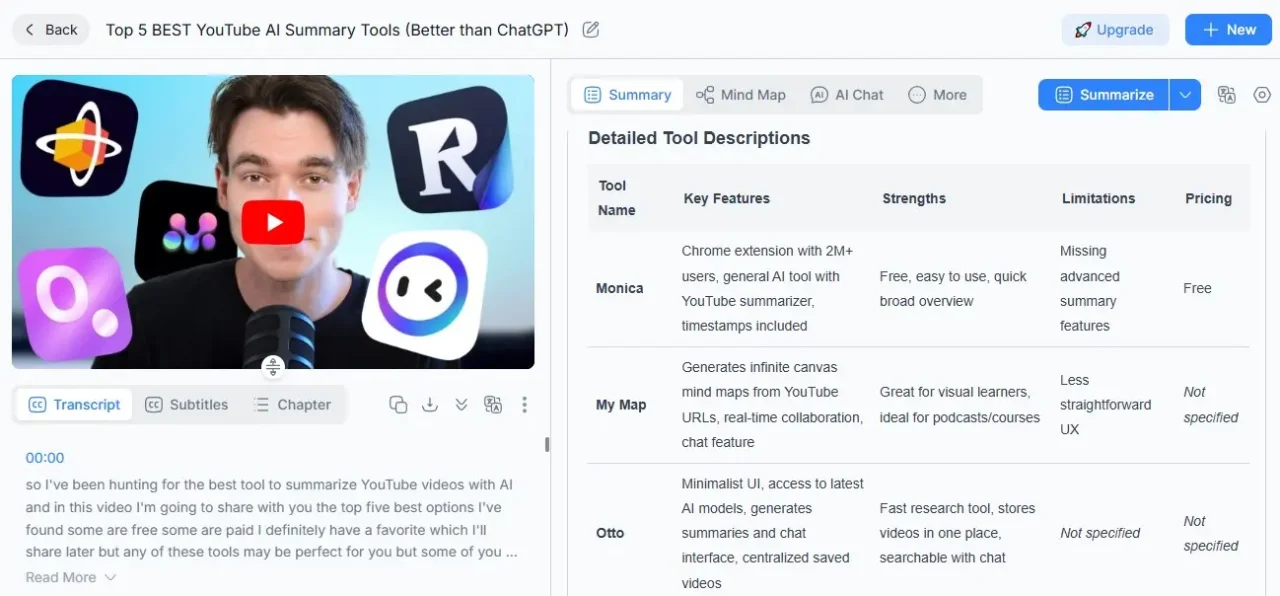
YouTube is already expanding AI-generated video summaries in some contexts. YouTube also has a conversational AI tool that can answer questions about the video you’re watching, right inside the player for some users.
And even outside YouTube, summarizing a video is already easy. Google Cloud documentation includes an official sample showing how to use Gemini to summarize YouTube videos, and Google also published a tutorial to build a Gemini-powered YouTube summarizer.
So the real question is not “Can AI summarize videos?”
It already can.
The real question is: If someone can get the full value from a 10-second summary, why would they keep watching your channel?
The 10-second test
Here’s the test I use:
If a viewer can read a short summary (or watch your first 10 seconds) and feel like they got the whole value, the video is usually too thin.
This often happens when the video is mainly:
- A definition with no depth
- A list of obvious tips
- Generic advice without proof
- News repeated from other sources
- A tutorial that shows steps but not decisions
- A “mistakes” video with no real examples
- A story that ends before it builds tension
Short videos are not the problem. Thin videos are the problem.
Why this matters more now
I already explained that there are many ways to get AI summaries for videos. Other than that, the points below also matter.
Low-effort mass video content is rising
There is also a visible rise of low-quality, mass-produced content. One report described a study that found more than 20% of videos shown to new YouTube users were “AI slop” in their analysis.
When low-quality content rises, platforms usually tighten their quality signals and enforcement. That makes “thin and replaceable” content riskier over time.
Monetization language is getting stricter about “inauthentic” content
YouTube updated its monetization policy language and renamed “repetitious content” to inauthentic content, clarifying that repetitive or mass-produced content is not eligible for monetization.
A lot of creators panicked about that update, so YouTube also clarified the intent publicly. For example, The Verge covered YouTube’s response about focusing on spammy, mass-produced content.
Even if monetization is not your goal today, this is a strong signal: YouTube is pushing toward original, authentic value.
The real risk is not AI summaries. The real risk is replaceability.
When creators hear “AI summaries,” many react by trying to:
- Cut intros harder
- Talk faster
- Pack more tips into less time
- Add more jump cuts
Pacing helps, but it does not fix the real issue.
If a viewer can get the same value from:
- Another creator saying the same thing
- A short AI summary
- A quick search
- A template video in your niche
Then your channel becomes easy to swap out.
So the goal is not making videos longer.
The goal is making videos harder to compress.
The 3 layers of value that survive the summary era
When I look at channels that feel “safe,” they usually deliver value in three layers.
Layer 1: Information
This is what summaries are best at.
- What happened
- What the feature is
- What the steps are
- What the definition is
If your video is only information, it is easy to summarize.
Layer 2: Interpretation
This is the “so what” part. Context and tradeoffs.
- Why it matters
- What changes in different cases
- What most people miss
- What depends on niche, budget, or skill level
- What to do first, second, third
Summaries can try to capture this, but they often lose nuance. That nuance is where you become valuable.
Layer 3: Experience
This is proof, mistakes, constraints, and real decision-making.
- Real tests and results
- Real failures and recoveries
- Real constraints (time, money, tools, team size)
- Real debugging steps when things go wrong
- Real examples from your work (anonymous if needed)
This layer is the hardest to summarize well, and it builds trust that outlives trends.
Build a watch moat that a summary cannot steal
I try to add at least one watch moat into every video idea. A watch moat is something a summary struggles to replace.
- Original data (tests, numbers, comparisons)
- Original access (your workflow, your niche, your market)
- Original thinking (frameworks, decision trees, scoring systems)
- Original storytelling (tension, obstacles, turning points)
- Original teaching (decisions and debugging, not just steps)
If you deliver none of these, your content becomes “summarize and move on.”
How to rewrite a summarizable video into a must-watch video
This is a practical rewrite process I use.
Step 1: Write the 10-second summary yourself
One or two sentences.
If that summary feels like it covers everything, the video is too thin.
Example:
“Today I’ll share 5 tips to grow on YouTube.”
That summary is basically the whole video. A summary tool can capture it perfectly.
Step 2: Pick one anchor moment the summary cannot capture
Choose one anchor that forces watching:
- A live demo
- A before-and-after result
- A mistake and recovery
- A comparison with numbers
- A turning point in the story
- A decision you made under real constraints
If your video is “5 tips,” the anchor might be: “Here is the one tip that doubled retention for me, and here is the exact change I made.”
That becomes harder to summarize into something satisfying, because viewers want to see it.
Step 3: Move the anchor earlier
Not necessarily in the first second, but early enough that people feel there is substance.
This is not clickbait. It is proof that your video has depth.
A simple rule that works: the viewer should see evidence within the first 30 to 60 seconds that the video contains something real.
Step 4: Use a spine that naturally holds attention
This structure works for tutorials, commentary, and education:
- Problem (what is failing, what’s at stake)
- Attempt (what most people try)
- Surprise (why it fails, what they miss)
- Fix (the real workflow)
- Result (what changed after applying it)
A summary can mention the result. It usually cannot preserve the full reasoning path, especially if you show real examples in each step.
Step 5: Add decision points
Decision points are where real value lives. This is what makes people think: “This creator saves me time.”
- If your channel is small, start here
- If your niche is crowded, avoid this trap
- If your audience is mostly mobile, do this first
- If you publish weekly, make this tradeoff on purpose
Decision points also make your content feel specific, not generic. Specific content is harder to summarize in a way that still feels complete.
For example, the video below is hard to summarize because it is about reading analytics and making decisions, not just “tips.”
What to watch in analytics (simple signals that tell the truth)
I don’t treat analytics like magic, but the patterns are real.
Here are signals I care about most:
- Audience retention (where people drop)
- Average view duration (is it improving over time)
- Returning viewers (do people come back)
- Comments quality (are questions deeper over time)
- Suggested traffic (are you being recommended next)
A sharp early drop often means:
- The intro is slow
- The title promise is not matched quickly
- The video gives the answer too early, with no extra payoff
- The viewer has no reason to continue after the gist
That last one is the summary risk.
If you want a simple workflow, do this for your next 5 uploads:
- Check the retention graph at 0:30, 1:00, and 2:00
- Write down the timestamp where the biggest drop happens
- Ask one question: “Did the viewer already get the main idea by now?”
- If yes, your video needs an earlier anchor, and stronger decision points
Case studies and proof patterns you can use (even with a small channel)
Case study pattern 1: One change, one measurable result
Pick one change that directly fights the summary problem:
- Moving the demo earlier
- Cutting a long intro
- Adding a decision framework
- Showing a failure and recovery
- Adding real numbers and screenshots
Then measure one thing:
- Retention curve before vs after
- Comments quality before vs after
- Returning viewers trend
- Watch time contribution per upload
Even with a small channel, “I changed X and here’s what happened” becomes a moat, because it is your real experience. Summaries can state the result, but viewers still want to understand the “why” and “how.”
Case study pattern 2: Proving summaries are becoming product features
If you want evidence that summarization is not a “future thing,” point to how Google teaches it. When Google publishes a codelab for building a YouTube summarizer, it’s a clear signal that summarizers are becoming normal apps, not experiments.
Also, tools like NotebookLM supporting YouTube sources push the same direction: “Give me the content, then give me the distilled key points.”
Case study pattern 3: Platform direction around mass-produced content
If you want a platform-level signal, reference YouTube’s own policy note about inauthentic content. It is a straightforward way to support your argument that “mass-produced, low-value content is a bad long-term bet.”
Format-specific fixes (because each niche gets summarized differently)
If you do news videos
News is extremely summarizable. Your moat is interpretation.
- Add consequences (what changes, who is affected)
- Add timelines (what happened before, what might happen next)
- Add comparisons (similar case, different outcome, why)
- Add decisions (if I were X, I would do Y first)
If you only repeat the news, the summary wins. If you explain what it means for different types of viewers, you win.
If you do tutorials
Basic steps are summarizable. Your moat is decision-making and debugging.
- Teach debugging (what to do when it fails)
- Teach decisions (why this setting, not the other one)
- Show constraints (budget, tools, time, skill)
- Explain tradeoffs (fast vs safe, cheap vs stable)
Many tutorials die because they answer “what to click,” but not “how to think.”
If you do commentary
Generic opinions are summarizable. Your moat is evidence and frameworks.
- React to specifics, not vibes
- Bring original examples
- Build a framework that helps viewers decide
- Explain what most people miss and why
A framework is powerful because it is reusable. Viewers come back for it.
If you do storytelling
Stories can be summarized, but good stories still keep attention.
- Build tension before the payoff
- Include obstacles and real decisions
- Make the outcome meaningful
- Show the cost of the wrong choice
A story that is honest about mistakes is hard to replace with a summary, because viewers connect to the experience, not just the plot.
A simple 30-day plan to reduce summary risk
If I wanted to reduce “summary risk” fast, I would do this for 30 days.
Week 1: Add proof to every video
- Pick one proof moment per video
- Move it earlier than usual
- Show one real example, not three vague tips
Week 2: Add decision points
- Add “If this, do that” sections
- Call out common traps
- Explain tradeoffs in plain language
Week 3: Build one repeatable framework
- Create a simple checklist or scoring system
- Apply it to two real examples
- Invite viewers to share their case and respond
Week 4: Publish one real case study video
- Choose one change you made
- Show what you can (retention curve, comments, watch time)
- Explain what you will do next based on the data
This creates a channel identity that is harder to summarize away.
Conclusion
If your videos can be summarized in 10 seconds, your channel is at risk because a viewer can get your value faster than you can deliver it.
The fix is not longer videos or louder hooks.
The fix is building a watch moat: proof, decisions, frameworks, real constraints, and teaching that goes deeper than the summary.
If you want one habit that changes everything, do this: write the 10-second summary first, then add one thing the summary cannot replace.