1) What are paid ads, and when do they make sense for a business?
Paid ads mean you pay to get targeted traffic fast, instead of waiting for SEO or organic social. They make sense when you have a clear offer and you can measure results.
Paid ads work best when:
- You know who your customer is (clear ICP)
- You have a landing page that explains one offer well
- You can track leads or purchases (pixel + events)
- Your margins can support the ad cost
Paid ads are a bad idea when your offer is unclear, your website is weak, or you do not know what “success” means. In that case, ads will only show you the problems faster.
A simple rule: if you cannot explain your offer in one sentence and one CTA, fix that first. Then ads become a growth tool, not a money leak.
2) Which platform should I start with: Meta Ads, Google Ads, LinkedIn, or TikTok?
Start with the platform that matches intent and your audience.
Quick guide:
- Google Search Ads: best when people already search for the solution (high intent)
- Meta Ads: best for demand creation and retargeting, strong for many B2C and some B2B
- LinkedIn Ads: best for B2B targeting by job title, but usually expensive
- TikTok Ads: best when you can make strong short-form creative and test fast
If your offer solves an urgent problem and people search for it, start with Google. If your offer needs education and good creative, Meta is often the best starting point.
Don’t spread budget across 3 platforms early. Pick one, learn, then expand.
3) What should I run first: traffic, leads, conversions, or sales campaigns?
Run the campaign that matches what you can measure and what your funnel is ready for.
If you can track purchases properly, go for Sales/Conversions. If you sell high-ticket services, go for Leads with a strong form or call booking. Use Traffic only when you have a clear reason, like warming audiences or building retargeting pools.
Many people choose Traffic because it looks cheap. But cheap clicks often bring low quality visitors. A better plan is:
- Conversions/Sales if tracking is correct
- Leads if you have a strong follow-up system
- Traffic only for specific testing, not as the main goal
The goal is not clicks. The goal is measurable business actions.
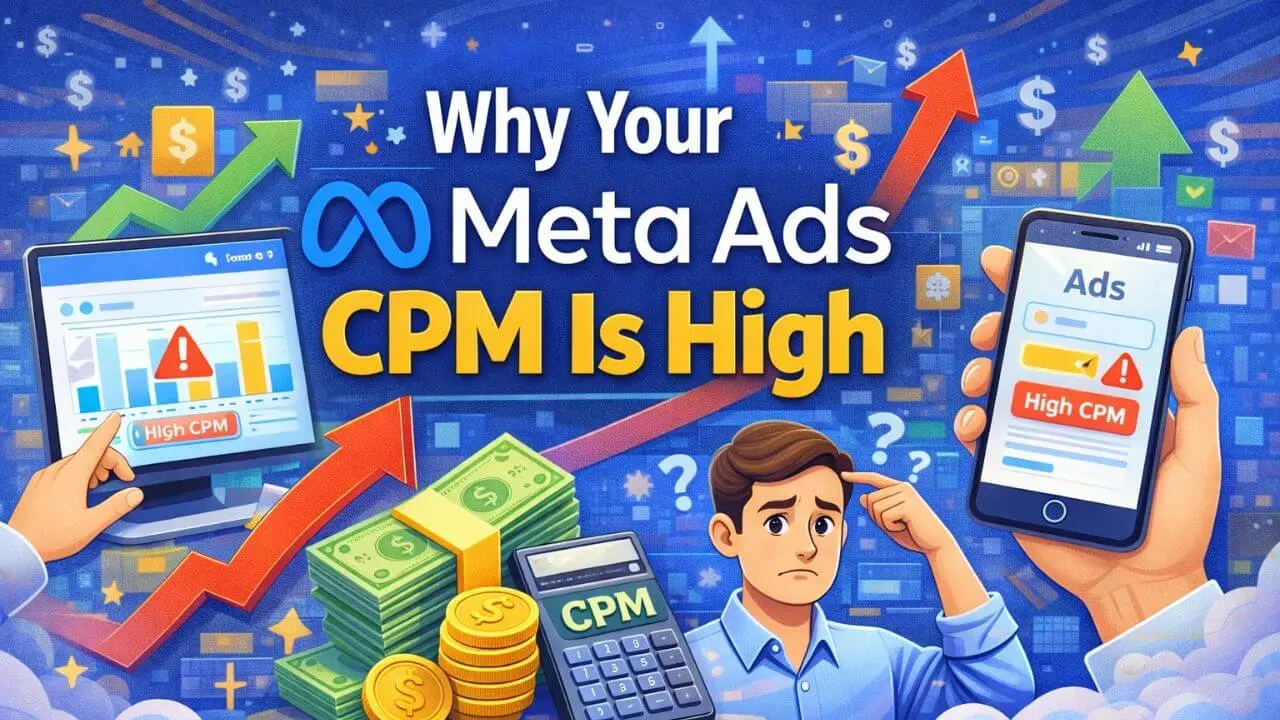
4) Why is my CPM high on Meta Ads, and what are the most common fixes?
High CPM usually means Meta thinks your ad will not get good engagement, or your audience is too competitive.
Common causes:
- Weak creative (boring or unclear)
- Narrow audience (too small)
- Too many advertisers targeting the same segment
- Low Quality Ranking or Engagement Rate Ranking
- Too many text-heavy images, or poor hook in video
Fixes that work in real life:
- Test 5–10 new creatives before changing anything else
- Use a broader audience and let the algorithm learn
- Improve your first 2 seconds in video or first line in text
- Try different angles: problem, outcome, proof, comparison
- Refresh creatives often if frequency is rising
CPM is not the enemy. Bad CPA is. Focus on cost per result, not only CPM.
5) What is a good CTR, CPC, and conversion rate? (and why these benchmarks can mislead)
Benchmarks are useful, but they can trick you because every niche is different.
A healthier way to think:
- CTR tells you if the creative is interesting
- CPC tells you if the platform is rewarding your ad
- Conversion rate tells you if your landing page and offer are clear
- CPA (cost per action) tells you if the whole system works
If CTR is low, improve creative. If CTR is fine but conversion rate is low, fix landing page or offer. If conversion rate is good but CPA is still high, you may need better targeting, better creatives, or better pricing.
Use benchmarks only to spot obvious problems. Your real benchmark is your own numbers improving week by week.
6) How much budget do I need to start paid ads without wasting money?
You don’t need a huge budget, but you do need enough to collect data.
A practical starting point:
- Small local service: start with a budget you can run for 2–4 weeks consistently
- E-commerce: enough to get multiple conversions per week
- B2B lead gen: enough to test multiple creatives and audiences
The key is consistency. If you keep turning ads on and off, the learning resets and results get worse.
Also set a testing budget mindset: the first spend is often for learning:
- Which offer angle works
- Which audience responds
- Which creative style wins
Then you scale what works.
7) How do I set up tracking properly (Pixel, CAPI, GA4) so I can trust results?
If tracking is wrong, you will make wrong decisions.
Basic setup checklist:
- Install Pixel (Meta) or Google tag correctly
- Track key events: view content, lead, purchase, call booking
- Use UTM parameters for every campaign
- Verify events are firing in Event Manager / Tag Assistant
- For Meta, consider CAPI if you have server-side options
Also decide your “source of truth”:
- Platform tracking is good for optimization
- GA4 is good for site behavior
- Your CRM or checkout is best for real revenue
If numbers don’t match, that is normal. What matters is direction and consistency. Make sure the important events fire correctly, then optimize based on CPA and lead quality.
8) What are the fastest ways to improve results without increasing budget?
Most improvements come from creative, offer, and landing page, not from hacks.
High impact fixes:
- Improve the offer: clearer promise, stronger proof, lower risk
- Add a better landing page headline that matches the ad
- Reduce friction: fewer fields, faster page, clear CTA
- Test new creatives weekly (this is the biggest lever on Meta)
- Use retargeting for visitors, video viewers, and engaged users
- Exclude existing customers when appropriate
If you are stuck, don’t keep tweaking tiny targeting settings. Make 3 new creatives and 1 landing page improvement first. Paid ads reward clear messages and strong user experience.




 Peak Lora is an AI-powered platform that curates, categorizes, and ranks the best content in Business & Startups, SEO, Content Marketing, Social Media Marketing, Paid Ads, and Web & CMS. It combines AI scoring with real user signals to highlight high-quality, fresh, and practical insights for founders, marketers, and creators.