
Most entrepreneur lists online repeat the same big names. They are good, but you can get a real advantage from smaller, quieter websites that offer practical ideas, real numbers, and usable frameworks without the hype.
This list focuses on sites that can help you choose better business ideas, validate faster, avoid common mistakes, and launch with less stress. Some are well-known in specific circles, but still not used enough by most founders.
1. BoringCashCow
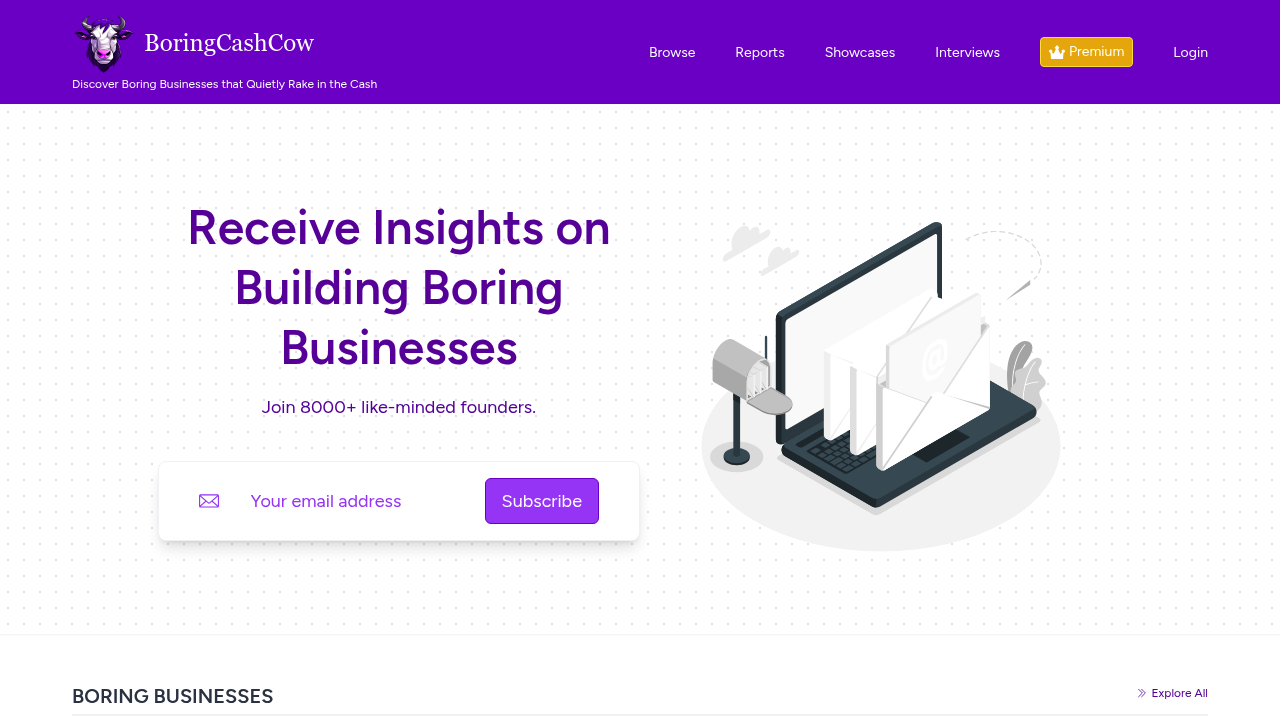
What it helps with: low-risk business ideas, realistic expectations, calm decision-making.
This site is useful because it promotes stable and proven business models. Many entrepreneurs lose months chasing high-risk ideas with unclear demand. BoringCashCow pulls you back to sensible opportunities.
A practical way to use it is to pick one idea and ask:
- Can I sell this within 30 days?
- Can I start small with simple systems?
- Can I reach customers without heavy ad spend?
If you can answer yes to most of these, you likely found a strong starting point.
Website: boringcashcow.com
2. Starter Story

What it helps with: learning real business models and founder execution.
Starter Story is one of the best places to study real founder journeys. It is especially valuable when you want to see what a business looks like beyond the “idea stage.”
Use it like a structured study tool:
- Choose one model you like: newsletter, agency, SaaS, ecommerce.
- Read three case studies.
- Write down one pattern you can test this month.
Website: starterstory.com
3. Failory

What it helps with: understanding why businesses fail.
Failory is a smart resource for building your risk awareness. Many people only read success stories. But failure stories often teach faster.
Before committing to a new idea, look for patterns related to:
- Pricing mistakes
- Wrong target audience
- Overbuilding too early
- High churn
Website: failory.com
4. Indie Hackers

What it helps with: real-world tactics for bootstrapped founders.
Indie Hackers is not rare, but still underused strategically. The real value is in the honest discussions around growth, revenue, and tiny experiments that work for solo founders.
A good method:
- Search for your business type.
- Find posts with numbers or clear lessons.
- Copy one small tactic instead of copying the whole strategy.
Website: indiehackers.com
5. YC Startup Library

What it helps with: high-quality founder education.
This is one of the highest-value free resources online. Even if you are not building a VC startup, the core lessons apply to any serious business.
Great topics include:
- Validating ideas
- Finding real customer pain
- Building something people want
- Early growth fundamentals
Website: Y Combinator Startup Library
6. Startup School

What it helps with: structured learning and founder discipline.
Startup School is useful if you like step-by-step guidance. It also pushes you toward consistent execution, which is where most early founders struggle.
Use it with a simple weekly plan:
- Set one clear goal.
- Track progress.
- Use the lessons to solve your current bottleneck.
Website: Startup School
7. Exploding Topics

What it helps with: finding rising trends early.
This is great for entrepreneurs who want to build around growing demand. The advantage is speed. You can spot demand patterns before a niche becomes crowded.
A simple workflow:
- Find one rising topic.
- Check real-world conversation around it.
- Test a small product or content angle.
Website: Exploding Topics
8. Glimpse (Google Trends Supercharged)

What it helps with:
- Finding keywords with real upward momentum
- Getting clearer trend signals (not just relative %)
- Comparing multiple search terms at once
- Spotting new demand before competitors
- Better decision support before committing to content, products, or niche ideas
Who it’s best for:
- Content creators planning topic calendars
- Founders validating demand before building
- Marketers spotting trends for campaigns
- SEO analysts checking keyword potential
Use it with Google Trends: Glimpse gives a more actionable layer on top of Trends’ raw interest data, making your demand research faster and clearer.
Website: Glimpse
9. Leanstack

What it helps with: idea validation and business model clarity.
Leanstack is useful when you want to convert a vague idea into a structured plan. The biggest benefit is forcing you to think about:
- Customer segment
- Unique value
- Key channels
- Revenue logic
This reduces the risk of building something “cool” that no one buys.
Website: Leanstack
10 Marketing Examples

What it helps with: practical marketing lessons with real examples.
This site is great for founders who want simple marketing ideas they can apply immediately. Instead of long theory, it focuses on short, clear breakdowns.
Use it when you need:
- Landing page inspiration
- Copywriting angles
- Simple growth experiments
Website: Marketing Examples
A smart way to combine these sites
Reading these sites one by one is useful, but the real power is when you combine them into a simple weekly system. Think of it like a funnel:
Pick an idea → validate demand → understand risks → plan the model → learn execution → market it
Here is a practical workflow you can repeat every week.
Step 1: Start with calm, low-risk ideas (BoringCashCow)
Open BoringCashCow and pick one idea that feels realistic for your time and budget.
Write down:
- Who pays for it (exact buyer type)
- What they pay for (exact outcome)
- How you can deliver it in the simplest way
If an idea needs heavy funding, a big team, or “go viral” luck, skip it.
Step 2: Check if demand is rising or stable (Exploding Topics + Google Trends)
Now do a fast demand check:
- Use Exploding Topics to see if the topic is growing.
- Use Glimpse & Google Trends to confirm it is not a short hype spike.
A simple rule:
- If Trends is flat but stable, it can still be good (boring businesses can win).
- If Trends is rising and not too crowded, it can be a strong timing advantage.
Also compare:
- Brand vs brand (to choose a better positioning)
- Country-by-country (to see where interest is stronger)
Step 3: Learn the “failure patterns” before you build (Failory)
Before you build anything, spend 15 minutes on Failory and look for similar businesses.
Try to find patterns like:
- “No clear niche”
- “Customer acquisition too expensive”
- “Churn is high”
- “Built too much before selling”
Then write 2–3 “risk notes” for your idea, for example:
- “If CAC is high, I will switch to SEO and partnerships.”
- “If churn is high, I will focus on one narrow use case first.”
This step saves months.
Step 4: Turn the idea into a clear business model (Leanstack)
Open Leanstack and fill a simple Lean Canvas (even a rough version is enough).
Focus on these parts:
- Customer Segment (one main segment only)
- Problem (top 1–3 pains)
- Unique Value Proposition (one clear sentence)
- Channels (how you get customers)
- Revenue Streams (how you get paid)
If you cannot explain the value in one sentence, you are not ready to build.
Step 5: Copy real execution, not motivation (Starter Story + Indie Hackers)
Now you need practical execution patterns:
- Use Starter Story to study 2–3 founders in the same business model.
- Use Indie Hackers to find tactical posts with numbers.
What to extract (write it down):
- Their first distribution channel (how they got first users)
- Pricing strategy (simple, not fancy)
- What they did in the first 30 days
- The smallest version that made money
Important: copy one tactic, not their full story.
Step 6: Get the fundamentals right (YC Startup Library + Startup School)
Use these two sites like a “quality filter”:
- YC Startup Library for high-quality thinking (especially “build something people want”).
- Startup School for consistent weekly execution and focus.
A simple weekly cadence:
- One lesson
- One action
- One measurable result
Don’t consume everything. Use them only to solve your current bottleneck.
Step 7: Improve your marketing output (Marketing Examples)
When you are ready to sell, go to Marketing Examples and pick one thing to improve:
- Landing page structure
- Headlines and positioning
- Offer clarity
- Email or onboarding flow
This is the best time to use it, because you can apply ideas immediately.
Why these “quiet” sites can be better than famous ones
Big platforms are valuable, but they can also create noise:
- Too many opinions
- Too many generic playbooks
- Too much hype
These smaller or more focused sites often offer:
- Clearer frameworks
- More grounded examples
- More founder-friendly thinking
That matters if you want steady progress with limited time.
Who this list is best for
These resources are especially useful if you are:
- A solo founder
- Building a Micro SaaS or AI tool
- Creating a directory or content-led business
- More interested in profitability than hype
- Working with a small weekly time budget
If your goal is consistent growth instead of viral luck, this set of websites will feel like a strong fit.
Conclusion
You don’t need dozens of tools to move forward. You need a small set of high-quality inputs that improve your decisions and reduce your risks.