
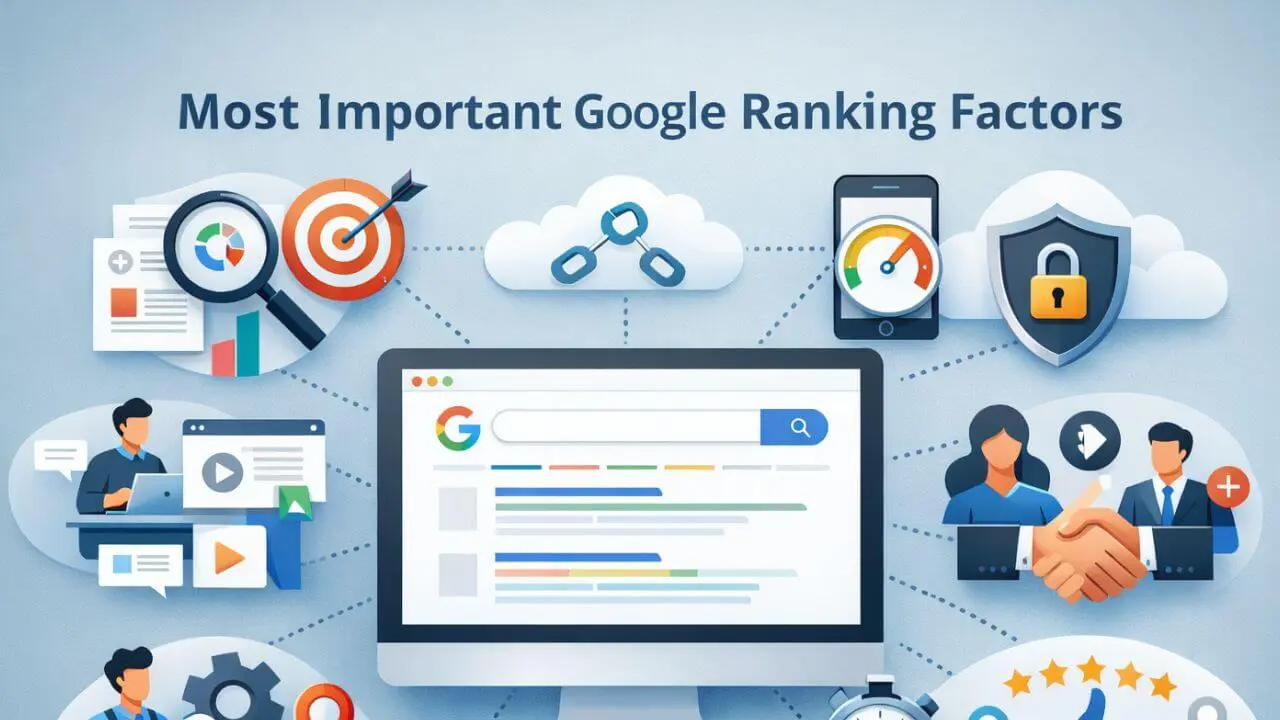
Google ranking is not one single thing. It is a mix of signals working together: your content quality, how well it matches search intent, your site trust, links, page experience, and even how your brand is mentioned online.
That’s why I made this ranking factors list in a practical way. Not to “game Google”, but to help you focus on what usually moves the needle in real projects. If you use this list correctly, you can improve rankings faster, avoid wasting time on low-impact tweaks, and build a site that keeps winning even when Google updates happen.
Before we start: how to use this list correctly
- Treat Google’s documentation as the rulebook. Start from what Google says it needs and wants. For example: helpful, reliable, people-first content, and technical eligibility. See Creating helpful, reliable, people-first content and Google Search technical requirements.
- Use studies to prioritize effort, not to “hack” Google. Correlation is still useful, but it is not proof. For example, Backlinko’s large studies show what tends to be common on top results, not what Google “guarantees” as a direct input. See Backlinko’s ranking factors overview.
- Optimize for ranking systems, not one update. Google explains many of its major systems in one place. Start here: A guide to Google Search ranking systems.
- Ranking factors are not in order, and “#1 factor” changes by keyword. Google does not apply one fixed ranking formula to every query. The weight of each factor changes based on the keyword, the competition, and the “risk level” of the topic.
For example:
- For a low competition keyword, strong Intent Match + Text Relevance + helpful content can be enough to rank, even with few backlinks.
- But for very competitive niches (loan, insurance, and even some digital marketing keywords), it’s often hard to reach page 1 without strong authority signals, especially high-quality backlinks and brand trust, even if your content is excellent.
So treat this list as a decision tool: “What matters most for this keyword and this SERP?”
Now the top 10.
1) Query Intent Match and Text Relevance (The Page Must Be the Best Answer)
If your page does not match search intent, nothing else saves it. You can have fast pages, strong backlinks, and perfect schema, and still not rank if the content solves the wrong problem.
Google explains that ranking tries to return the most relevant and useful results. See How Search works: Ranking results and In-depth guide to how Google Search works.
A big external dataset also points the same way. Semrush’s study focuses heavily on relevance signals and relationships between results and ranking positions. See Semrush ranking factors study and the study landing page that states they analyzed 300K results: Semrush Study: Ranking Factors 2024.

What to do (fast, practical):
- Write a one-sentence intent statement before writing: “This page helps someone who wants X do Y without Z.”
- Cover the full task, not just definitions. Include steps, examples, edge cases, and common mistakes.
- Answer the question early, then expand. Don’t hide the solution under long intro text.
Simple test: If someone reads only your headings, do they feel “this solves my exact problem”?
2) Spam Safety and Policy Compliance (Stay Eligible to Rank)
This is not “optional.” If you cross the line into spam tactics, you can be ranked lower or removed.
Start with Google’s official rules: Spam policies for Google Web Search.
In March 2024, Google also announced new spam policies and stronger enforcement (including scaled content abuse, site reputation abuse, and expired domain abuse). See What web creators should know about our March 2024 core update and spam policies and Google’s announcement post: New ways we’re tackling spammy, low-quality content.
What to do (high impact):
- Avoid scaled content abuse. Do not publish mass pages that add no unique value.
- Avoid site reputation abuse. Don’t host “other people’s junk content” on your domain just to rank.
- Avoid thin affiliate pages. If you recommend tools, add real testing, screenshots (optional), real pros and cons, and clear comparisons.
If you build Peak Lora-style “curation + summaries,” the key is: unique value per page (your own evaluation, context, and next steps), not copied blurbs.
3) Helpful, People-First Content That Adds Something New
Google’s direction is very clear: it wants content created to help people, not content created mainly to rank. This is not a “single update” anymore. Google explains the helpful content system is part of core systems. See Ranking systems guide: Helpful content system and Creating helpful, reliable, people-first content.
What “helpful” looks like in real pages:
- You include experience-based details (what worked, what failed, what to do first).
- You cover decision points (when not to do something).
- You include checks and validation (how to confirm the fix worked).
Uncommon insight that works well in 2026:
Add a small section called “If you only do 3 things” and list 3 actions that solve 80% of cases. This increases usefulness and keeps readers on track.
4) Trust Signals and E-E-A-T for the Topic (Especially YMYL)
Google’s Quality Rater Guidelines are not the algorithm, but they show what Google considers high quality and trustworthy. Google also officially introduced E-E-A-T (Experience, Expertise, Authoritativeness, Trust). See Google’s blog about E-E-A-T
For topics like health, finance, safety, and major life decisions, trust is a deal-breaker.
What to do (without “fake authority”):
- Add an Author box with real background and what you have done.
- Add sources when you claim facts (you asked for this, and it helps a lot).
- Add last updated date and actually update the page when things change.
- Add editorial standards (short page: how you pick sources, how you correct errors).
I have added all abouve things in Peak Lora, if you study this post, you can find all above.
I have added all the above things in Peak Lora. If you study this post, you can find everything mentioned above.
5) Backlinks and Authority (Quality, Relevance, and Earning Them the Safe Way)
Links still matter, but the way you build links matters more than ever.
Google explicitly references link analysis and PageRank as part of its systems. See A guide to Google Search ranking systems.
Industry datasets still show strong relationships between backlinks and ranking or traffic.
For example, Backlinko’s large-scale analysis looks at correlations across millions of results: We analyzed 11.8 million Google search results.
Ahrefs also has a practical test showing ranking and traffic dropped after disavowing links and improved after removing the disavow (a strong real-world signal that links matter): Do links still matter for rankings?.

What to do (safe link strategy):
- Build link-worthy assets: original data, templates, checklists, mini-tools, or strong comparisons.
- Earn links via real outreach: “Here is a useful resource you can cite,” not “please link to me.”
- Prefer relevant sites with real traffic, not random high DR pages.
Also remember: Google is actively fighting link abuse and low-quality tactics. Keep your link building aligned with spam policies and avoid manipulative patterns.
6) Topical Coverage and Internal Linking (Your Site Must Make Sense)
Google needs to understand:
- What this page is about.
- How it connects to your other pages.
- Which page is the main page for a topic.
This is where topic clusters and internal links become a ranking advantage, especially for small sites.
What to do:
- Create a pillar page for each main topic.
- Build supporting articles that answer specific questions.
- Use internal links like a map:
- Pillar links to supporting posts.
- Supporting posts link back to the pillar.
- Supporting posts cross-link when relevant.
7) Crawlability and Indexability (If Google Can’t Access It, It Can’t Rank)
This is a “boring” factor, but it is brutally important because it is a gate. Google’s minimum technical requirements are very clear: Googlebot must not be blocked, the page must return success, and it must have indexable content.
Common issues that silently kill rankings:
- robots.txt blocks important paths
- Accidental noindex on templates
- Soft 404 pages
- Heavy JS rendering issues for the main content
- Wrong canonicals that point elsewhere
What to do:
- Use Search Console’s indexing reports and URL inspection.
- Make sure important pages return HTTP 200 and have real indexable content.
- Keep canonical tags correct and consistent.
8) Mobile-First Quality (Google Uses Mobile Content for Indexing and Ranking)
Google uses the mobile version of your content for indexing and ranking. That is mobile-first indexing. See Mobile-first indexing best practices.
Google also completed its final move for the remaining small set of sites in July 2024. See the official post: Mobile indexing final step.
What to do (simple checklist):
- Make sure mobile has the same main content as desktop.
- Do not hide content or links on mobile that matter for SEO.
- Use readable font sizes and spacing.
- Avoid interstitials that block content.
If your mobile version is “thin,” you are fighting with one hand.
9) Page Experience and Core Web Vitals (Not the Main Driver, But a Real Edge)
Google recommends good Core Web Vitals and connects it to overall page experience. See Understanding Core Web Vitals and Google Search results.
Also, INP replaced FID as a Core Web Vitals metric in March 2024. See Introducing INP to Core Web Vitals and the web.dev announcement: INP is officially a Core Web Vital.
Be realistic: Core Web Vitals usually won’t rank a weak page above a great page. But in close competitions, performance and UX can help. It also helps conversion.
What to do (high ROI):
- Fix LCP (optimize hero image, reduce render-blocking).
- Fix INP (reduce heavy JS, break long tasks, avoid too many scripts).
- Fix CLS (set image sizes, avoid layout shifts from ads, fonts, and banners).
10) Structured Data and SERP Presentation (You Don’t “Rank With Schema,” You Win More Clicks)
Structured data helps Google understand content and can make you eligible for rich results. But it does not guarantee rich results. Google states this clearly in its structured data policies. See General structured data guidelines.
Even if ranking stays the same, better presentation can improve CTR, and higher CTR can increase real traffic and brand growth.
What to do:
- Implement schema only where it matches the visible content.
- Use JSON-LD where possible (Google recommends it).
- Validate using Google’s tool: Rich Results Test.
A practical “Do This First” plan (So you don’t get stuck)
Week 1: Build the base
- Fix indexability issues using Google technical requirements
- Confirm mobile and desktop content parity using mobile-first best practices
- Remove risky patterns using spam policies
Week 2: Upgrade content quality
- Rewrite top pages to match intent better using helpful content guidance
- Add experience and decision points
- Add sources inside the content
Week 3: Authority and internal structure
- Build topic clusters and strong internal linking
- Publish 1 to 2 link-worthy assets
- Start a safe outreach process
Week 4: Performance and presentation
- Improve Core Web Vitals using Core Web Vitals guidance
- Add structured data carefully using structured data policies
Conclusion
In 2026, SEO is simpler than most people think and harder than most people expect.
It is simpler because the priorities are clear: match intent, publish genuinely helpful content, stay inside spam rules, build real authority, and keep the site technically accessible. Google’s own docs repeat these themes across its ranking systems and Search Essentials:
It is harder because you can’t win with shortcuts anymore. The fastest path is to build pages that are truly the best answer, then support them with trust, strong internal structure, and earned authority links.