If you publish a page today, it can feel like nothing happens for weeks, then impressions show up, then a small ranking jump happens, then it goes quiet again. That pattern is normal.
In 2026, the honest answer is still: it depends. But you can predict your likely timeline if you understand what “rank” really means, what Google needs to trust your site, and what slows pages down.
This guide gives realistic timeframes, what makes ranking faster or slower, and a simple plan you can follow.
First, define what “rank” means
When people say “I want to rank on Google,” they usually mean one of these:
- Indexed: Google has discovered your URL and can show it in search results.
- Getting impressions: Your page starts appearing for some queries (even if it’s page 5).
- Ranking for target keywords: You show up for the keywords you actually care about.
- Ranking in the top 10: First page visibility.
- Ranking in the top 3: Where clicks usually become meaningful.
- Staying there: Rankings stabilize, not just a short spike.
These stages have different timelines.
Google’s own guidance is that changes can show impact quickly in some cases, but it can also take months for systems to learn and confirm quality and consistency.
The 2026 reality: ranking is slower for most sites
Two big reasons explain why:
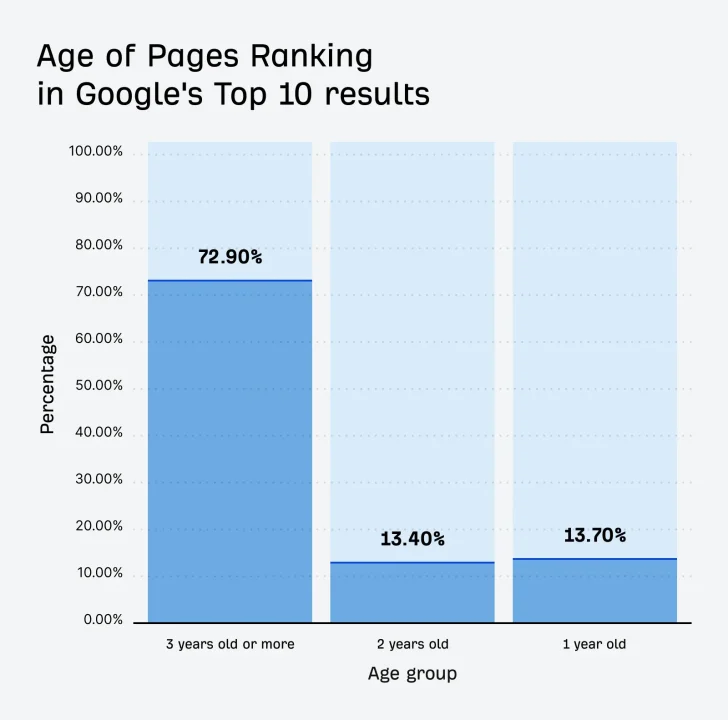
1) Google rewards proven pages more than ever
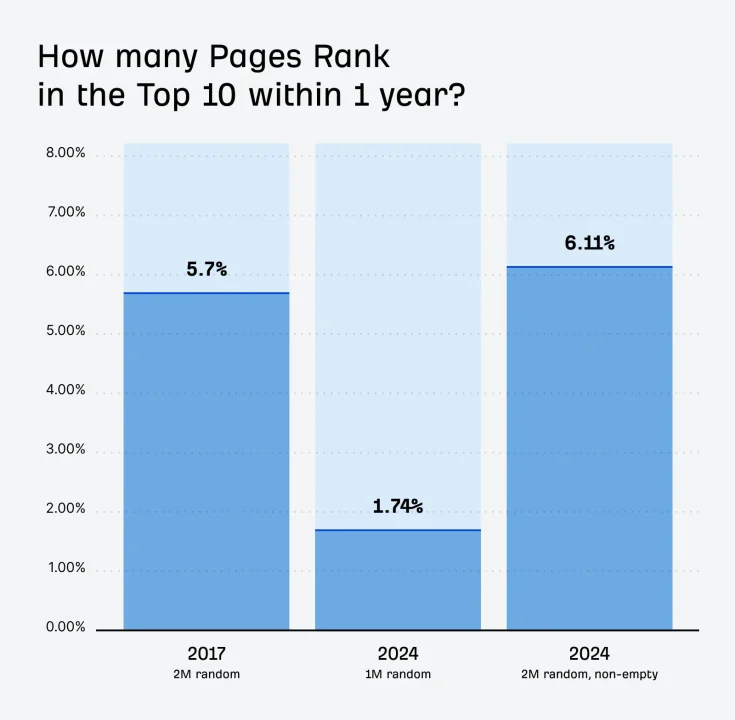
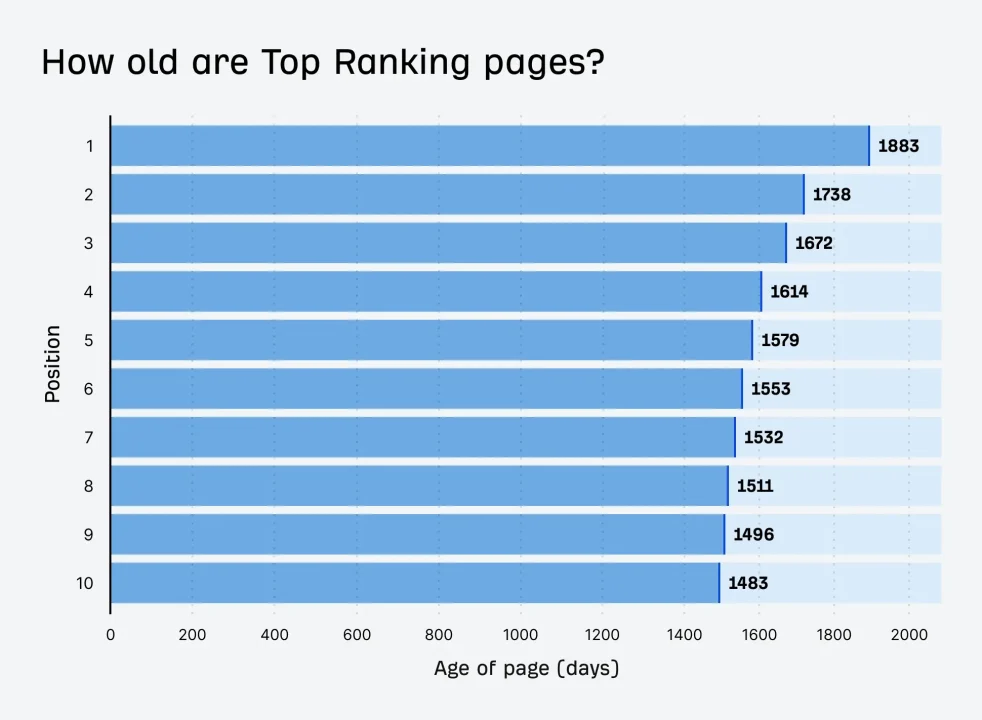
A well-known Ahrefs study found many top results are older pages, not brand-new ones. That does not mean new pages cannot rank. It means competitive topics often have pages with years of links, updates, and user signals behind them. Here is the study: Ahrefs: How Long Does It Take to Rank in Google?
You can see a few graphs that are published in the above Ahrefs data-based study.
2) Search results move more because Google updates often
Core updates can roll out over weeks. During and after these updates, rankings can shift even if you did nothing.
That’s why ranking sometimes feels random. It is often Google testing, re-evaluating, and rebalancing results.
Typical timelines in 2026 (realistic expectations)
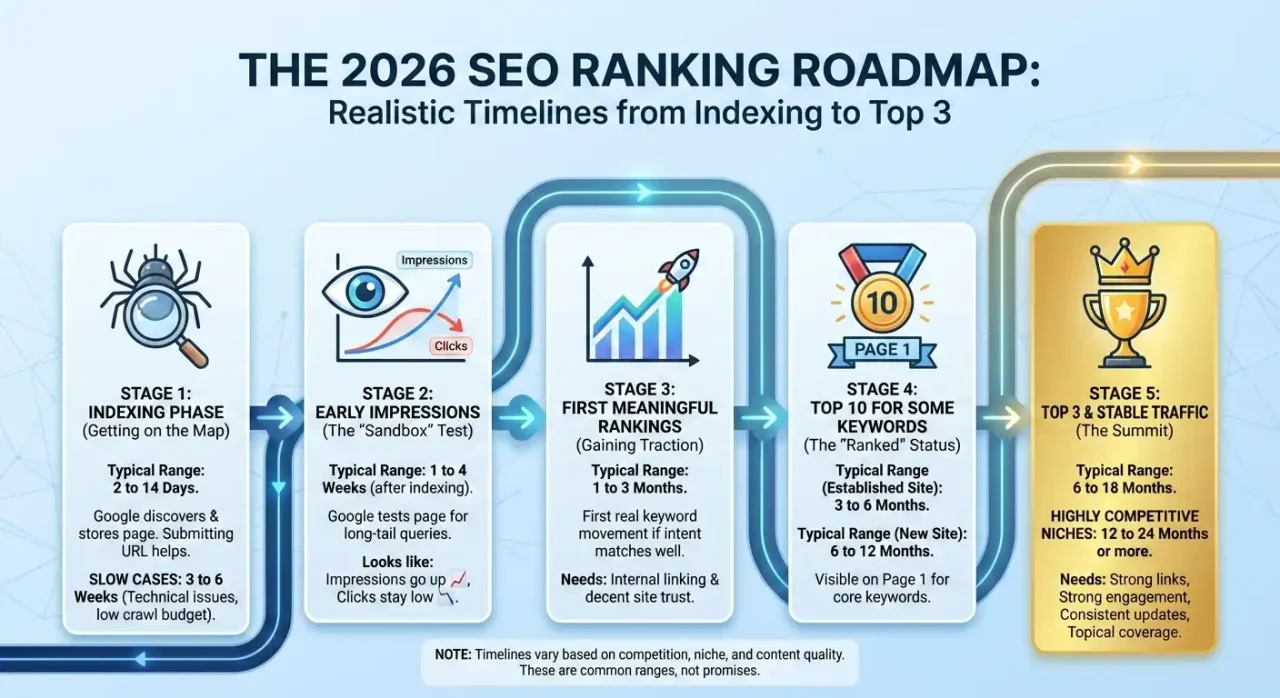
Think of these as common ranges, not promises.
Stage 1: Indexing (usually days, sometimes weeks)
Google says new content can be indexed in a few days, and submitting the URL can help.
Typical range: 2 to 14 days
Slow cases: 3 to 6 weeks (low crawl frequency, weak internal linking, site quality issues, or technical problems)
Stage 2: Early impressions (often 1 to 4 weeks after indexing)
This is when Google starts testing your page for long-tail queries. You may see impressions with low average positions.
Typical range: 1 to 4 weeks
What it looks like: impressions go up, clicks stay low
Stage 3: First meaningful rankings (often 1 to 3 months)
If the page matches intent well, is internally linked, and your site has decent trust, the first real keyword movement often happens here.
Typical range: 30 to 90 days
Stage 4: Top 10 for some keywords (often 3 to 6 months)
This is the stage most people mean when they say “rank.”
Typical range for an established site: 3 to 6 months
Typical range for a new site: 6 to 12 months
Stage 5: Top 3 and stable traffic (often 6 to 18 months)
Top 3 usually needs more than “good content.” It often needs:
- Strong links (or strong brand signals)
- Strong engagement
- Consistent updates
- Topical coverage across multiple pages
Typical range: 6 to 18 months
Highly competitive niches: 12 to 24 months or more
The biggest factors that decide your ranking speed
1) Your site’s existing trust
If your domain already ranks for related topics, new pages can rank faster because Google already understands your site and may crawl it more often.
If you are starting a new site or moving into a new topic area, expect slower movement.
2) Search intent match (this beats word count)
If the query needs a comparison, and your page is a story, you can wait 12 months and still not rank.
A simple intent checklist helps:
- Is the content type correct (guide, list, tool, product page, forum)?
- Is the angle correct (beginner, advanced, local, pricing-focused)?
- Is the format correct (steps, checklist, templates, examples)?
If your page does not match what Google is rewarding, time will not fix it.
3) Competition level
This is the fastest way to estimate timeline:
- Low competition long-tail: 2 to 8 weeks for top 10
- Medium competition: 3 to 6 months
- High competition money keywords: 9 to 24 months (or never, unless you build authority)
4) Internal linking and crawl paths
If a page is “orphaned” (no internal links pointing to it), ranking is usually slow.
Strong internal linking does two things:
- helps Google discover the page faster
- passes relevance and importance signals from existing pages
5) Link signals (quality beats quantity)
Backlinks still matter, especially when two pages are equally good.
The shortcut is not spam links. The shortcut is earning a few relevant links from pages that are real and trusted in your niche.
6) Technical health (important, but not the main driver)
Perfect Core Web Vitals will not rank a bad page.
But technical problems can block ranking:
- slow or failing servers
- broken canonicals
- noindex mistakes
- poor mobile UX
- duplicate content that confuses Google
A good baseline is to follow Google’s technical guidance and keep Search Console clean.
7) Content reliability and “who wrote it”
Google pushes helpful, reliable, people-first content, and also says some changes can take time to be reflected across systems.
This is where E-E-A-T shows up in real life:
- Clear author identity
- Real experience and examples
- References to trusted sources
- Unique insights that are hard to copy
- Consistent quality across the site
A simple forecasting model to estimate your own timeline
Score each question from 0 to 2.
- Does the site already rank for similar topics?
- Is the keyword clearly long-tail and low competition?
- Does the page format match what top results show?
- Is the page strongly internally linked from relevant pages?
- Is there a realistic plan to earn a few relevant backlinks?
Score interpretation:
- 8 to 10: possible top 10 in 4 to 12 weeks
- 5 to 7: likely top 10 in 3 to 6 months
- 0 to 4: expect 6 to 18 months, or choose a better target
What to do in the first 30 days (this is where most time gets wasted)
Week 1: Make discovery and indexing easy
- Submit the URL in Search Console (URL Inspection)
- Add internal links from:
- your homepage (only if it makes sense)
- a relevant category page
- 2 to 5 related posts
- Confirm it’s indexable (no noindex, correct canonical)
- Ensure it’s in your XML sitemap
Week 2: Make the page the best match for the query
Do not just add more words. Make the page closer to the “winning pattern” in the SERP.
Common upgrades that speed up ranking:
- Add a short, quick answer near the top (2 to 5 lines)
- Add specific examples (real scenarios, numbers, steps, tools)
- Add a short “what to do next” checklist
- Add an FAQ section based on real queries you see in Search Console
Week 3: Build a small supporting cluster
One strong page is good. One strong page plus a few supporting pages is better.
Create 3 to 5 supporting posts that target:
- Subtopics
- Long-tail variations
- Beginner questions
- Related templates or checklists
Then link them together naturally.
Week 4: Earn at least one real link
Not 50 low-quality directory links. One real link is more valuable.
Practical methods that work when your content is genuinely useful:
- Reach out to small blogs that already list resources in your niche
- Offer a unique checklist or template they can reference
- Publish a small study (even a small dataset can earn links)
What to expect from months 2 to 6 (the “Google is testing you” phase)
This is where most pages bounce around.
Common patterns:
- Google tests your page for many long-tail queries
- Rankings jump and drop
- Impressions rise before clicks
- The page stabilizes only after it proves a consistent value
During this phase, focus on:
- Improving sections that get impressions (Search Console is the guide)
- Adding internal links from newer relevant posts
- Updating the intro to match intent better
- Tightening headings and structure (without stuffing keywords)
The 2026 twist: AI features change what “success” looks like
Even if you rank, you may get fewer clicks for some queries because users get quick answers on the results page.
So in 2026, success is measured better like this:
- Impressions for high-intent queries (not just volume)
- Clicks that lead to engagement (time on site, signups, leads)
- Rankings for deeper intent queries where users still click
- Visibility across multiple pages, not one hero post
Mistakes that make ranking take much longer
Mistake 1: Publish and wait
If you publish and do not build internal links, do not update based on real data, and do not create supporting pages, progress is usually slow.
Mistake 2: Target one big keyword as a new site
If your site is new, big keywords are often a long game.
Start with long-tail keywords and build topical authority first.
Mistake 3: Content that looks complete but is not useful
A page can look long and still be weak.
Strong pages usually include:
- Real experience and examples
- Specific steps
- Edge cases and tradeoffs
- Clear recommendations per scenario
Mistake 4: Trying shortcuts that violate policies
Google has spam policies, and it also talks about “site reputation abuse” where content is placed on trusted sites to exploit their ranking signals. If a strategy depends on tactics like that, ranking can become unstable or disappear.
A ranking timeline you can share with clients
- Indexing: a few days to a few weeks
- Early impressions: 2 to 6 weeks
- First meaningful movement: 1 to 3 months
- Top 10 for some targets: 3 to 6 months (established sites), 6 to 12 months (new sites)
- Top 3 and stable growth: 6 to 18 months
This is the most realistic expectation for most businesses in 2026, assuming steady improvements and no major technical blocks.
Conclusion
In 2026, ranking is not one moment. It is a set of stages: indexing, impressions, first movement, top 10, top 3, and stability.
If your site already has trust and you target smart long-tail keywords, results can show within 1 to 3 months, with top 10 often possible within 3 to 6 months. If the site is new or the keywords are highly competitive, 6 to 18 months is a more honest range.
The most reliable approach is simple: match intent, build a small topic cluster, strengthen internal links, and improve the page using real Search Console data. Do that consistently, and your ranking timeline becomes predictable instead of stressful.


 Peak Lora is an AI-powered platform that curates, categorizes, and ranks the best content in Business & Startups, SEO, Content Marketing, Social Media Marketing, Paid Ads, and Web & CMS. It combines AI scoring with real user signals to highlight high-quality, fresh, and practical insights for founders, marketers, and creators.